Support our educational content for free when you purchase through links on our site. Learn more
35 Must-Have Items for International Travel 🌍

The must-have items for international travel are the ones that protect your access, health, and comfort: valid travel documents, backup payment methods, essential medication, a charged phone, and a carry-on kit that can get you through a delay. Add a suitable travel adapter, destination-ready clothes, and only the extras you’ll genuinely use.
We’ve learned that the tiny things can save a travel day: a pen for an unexpected form, a power bank when your boarding pass lives on your phone, or a clean shirt when your suitcase takes the scenic route. Use this list as a practical starting point, then tailor it to your destination, airline, and itinerary—because packing for a city break and packing for a week of hiking are very different sports.
Key Takeaways
- Keep essentials close: Pack your passport, medication, payment cards, phone, charger, and a change of clothes in your carry-on.
- Check the details early: Verify passport and visa requirements, airline baggage rules, medication restrictions, and destination health advice.
- Choose the right power gear: A travel adapter changes plug shape; a voltage converter changes electrical output. They are not the same.
- Pack for your actual trip: Match clothing, shoes, and activity gear to the weather, local customs, and itinerary.
- Build in backups: Carry a second payment method, secure document copies, and offline access to key travel information.
- Treat the list as a menu, not a mandate: Comfort items like an e-reader, camera, or travel pillow are optional—bring what earns its space.
Table of Contents
- ⚡️ Quick Tips and Facts for International Travel
- 🌍 Why Packing for International Travel Takes a Little Extra Planning
- 🧳 Must-Have Items for International Travel: The Complete Packing List
- 1. Passport, Visa, and Entry Documents
- 2. Travel Insurance and Emergency Information
- 3. Copies of Important Documents
- 4. International Debit and Credit Cards
- 5. A Small Amount of Local Currency
- 6. A Secure, RFID-Blocking Wallet or Passport Holder
- 7. A Lightweight, Packable Backpack
- 8. A Carry-On Bag That Meets Airline Rules
- 9. Luggage Tracker or AirTag
- 10. Universal Travel Adapter and Voltage Converter
- 11. Portable Charger and Charging Cables
- 12. An Unlocked Phone, eSIM, or International SIM Card
- 13. Offline Maps, Translation, and Travel Apps
- 14. Noise-Canceling Headphones or Earplugs
- 15. Blackout Eye Mask and Travel Pillow
- 16. Reusable Water Bottle with a Purifying Option
- 17. Lightweight Camera and Memory Cards
- 18. Kindle or Other E-Reader
- 19. Packing Cubes and Compression Bags
- 20. Laundry Detergent Sheets
- 21. Travel Umbrella or Packable Rain Jacket
- 22. Comfortable Walking Shoes and Backup Footwear
- 23. Versatile Clothing for the Destination and Season
- 24. Compression Socks for Long-Haul Flights
- 25. Eye Drops, Lip Balm, and Hand Cream
- 26. Personal Medication and a Basic First-Aid Kit
- 27. Hand Sanitizer, Wipes, and Tissues
- 28. Sunscreen and Insect Repellent
- 29. Reusable Shopping Bag and Small Day Bag
- 30. Travel Laundry Bag and Shoe Bags
- 31. Snacks for Flights and Travel Delays
- 32. Notebook, Pen, and Luggage Tags
- 33. Travel-Safe Door Lock or Door Alarm
- 34. A Small Comfort Kit for the Flight
- 35. Optional Wellness Extras: Probiotics, Green Powder, and Tea
- 🎒 What to Pack in Your Carry-On for an International Flight
- The Personal-Item Essentials to Keep Close
- TSA Liquids, Medication, and Battery Rules
- 🔌 International Travel Electronics and Power Guide
- Adapter vs. Converter: What’s the Difference?
- How to Check Voltage, Plug Types, and Device Compatibility
- 🩺 Health, Hygiene, and Comfort Essentials Abroad
- Medication, Prescriptions, and Destination Rules
- Staying Hydrated, Rested, and Comfortable on Long Flights
- 🔐 Travel Safety and Protecting Your Belongings
- Scams, Pickpockets, and Hotel-Room Safety
- Digital Safety: Backups, Passwords, and Public Wi-Fi
- 🗺️ Destination-Specific Packing: Weather, Culture, and Activities
- Beach, City, Hiking, and Business-Trip Add-Ons
- Modest Clothing and Local Customs
- ✅ International Travel Packing Checklist by Timeline
- Before You Book and Before You Fly
- The Night-Before Checklist
- ❌ What Not to Pack for an Overseas Trip
- 💡 Smart Packing Tips to Save Space and Avoid Extra Baggage
- ❓ Frequently Asked Questions About International Travel Essentials
- What should I always bring when traveling internationally?
- What should go in my personal item?
- Do I need a voltage converter or just a travel adapter?
- How do I keep my passport and valuables safe?
- How can I pack light for a two-week international trip?
- Conclusion
- Recommended Links
- Reference Links
⚡️ Quick Tips and Facts for International Travel
International travel gets easier when you separate must-haves from “this seemed useful at home.” First, check the often-forgoten items that belong on every travel checklist, then tailor your packing list to your destination, airline, trip length, and health needs.
| Quick fact | What to do |
|---|---|
| Passport rules vary by destination | Check your destination’s entry requirements and passport validity rules well before departure. Some countries require months of validity beyond your stay. |
| Plug shape and voltage are different questions | A plug adapter changes the shape; a voltage converter changes electrical output. Check device labels before plugging in. |
| Power banks usually belong in carry-on baggage | Follow your airline’s battery rules and check current FAA guidance. |
| A phone is not a backup plan if it is your only copy | Keep important details available offline and maintain a secure backup of essential documents. |
| Carry-on space is precious | Keep medication, travel documents, valuables, chargers, and a change of clothes with you. |
| Water filters do not all purify water | A taste-improving carbon filter is not necessarily designed to make unsafe water safe. Follow the product’s stated capabilities and official destination health guidance. |
Our practical rule: pack for the trip you’re taking, not every trip you might someday take. A city weekend, a month of backpacking, and a beach holiday do not need identical luggage. For trip planning, browse our Backpacking Checklists, Budget Travel Checklists, and Adventure Travel Checklists.
🌍 Why Packing for International Travel Takes a Little Extra Planning
Packing for an international trip means preparing for more than a long flight. You may cross time zones, use unfamiliar outlets, encounter different medicine rules, arrive after local shops close, or find that your checked bag has decided to take a separate holiday.
We’ve learned to plan around three kinds of risk:
- Access risk: Can you reach your passport, money, medications, and booking details when you need them?
- Comfort risk: Can you sleep, hydrate, stay warm, and manage small inconveniences during long travel days?
- Disruption risk: If a flight is delayed or luggage goes missing, can you get through the first day or two?
Travel writers often emphasize different items because they travel differently. One traveler’s perfect setup may include a camera and tripod; another’s is a phone, a tiny charger, and an empty tote. One packing guide calls its recommendations items the author “I don’t leave home without,” while another emphasizes carrying enough in your cabin bag to get by for “a day or two” if checked luggage is delayed. Both are useful perspectives: personal favorites are not universal requirements, but essentials that protect health, access, and flexibility deserve priority.
The first video’s advice adds a useful old-school layer to modern packing: split your cards, carry a daypack, use packing cubes, and keep digital copies of key documents. We’d add one caution: a money belt can help keep valuables discreet, but it should not become a single magic pocket holding every card and all your cash. Distribute backups. The video’s full perspective is available at #featured-video.
🧳 Must-Have Items for International Travel: The Complete Packing List
This list is deliberately broad. Use it as a master checklist, then remove anything that does not suit your itinerary. We group practical essentials alongside optional comfort items so your bag doesn’t turn into a traveling department store.
| Priority | Pack these first | Add when relevant |
|---|---|---|
| Essential | Passport, entry documents, medication, payment cards, phone, charger | Travel insurance details, printed itinerary, local currency |
| Highly useful | Carry-on change of clothes, adapter, power bank, comfortable shoes | eSIM, water-treatment device, luggage tracker |
| Comfort | Eye mask, earplugs or headphones, moisturizer, reusable bottle | Travel pillow, Kindle, compression socks |
| Trip-specific | Weather-appropriate clothing, day bag | Camera, hiking gear, beach gear, modest layers |
1. Passport, Visa, and Entry Documents
Your passport is the most important item in your bag, and the least helpful one to discover is expired. Check passport validity, visa requirements, transit rules, and any entry forms using official government sources. The U.S. Department of State country information pages are a useful starting point for U.S. travelers; travelers from other countries should also check their own government’s travel advice.
Before you go:
- Confirm the passport is valid for the destination’s required period.
- Check whether you need a visa, electronic travel authorization, or transit visa.
- Confirm the name on your ticket matches your travel document.
- Save approval emails and application references offline.
- Keep a pen in your personal item in case you need to complete a paper form.
A passport cover can protect the document, but remove it when presenting your passport for inspection. Keep your passport secure but accessible: burying it at the bottom of a fully packed suitcase is secure in the same way a locked car is secure when you’ve lost the keys.
2. Travel Insurance and Emergency Information
Travel insurance can help with covered medical emergencies, trip interruptions, or lost baggage, depending on the policy. Read the exclusions instead of relying on the brochure’s sunny illustrations. The U.S. Department of State’s travel insurance guidance explains why travelers should understand overseas medical coverage and evacuation benefits.
Keep these details accessible:
- Insurer name and policy number
- Emergency assistance phone number
- Coverage limitations and claim instructions
- Emergency contacts
- Relevant medical conditions and allergies
Don’t assume your regular health plan covers care abroad. Call your insurer and ask what is covered at your destination, whether you need to pay upfront, and how to reach assistance.
3. Copies of Important Documents
Make secure copies of your passport, visa, insurance details, prescriptions, and bookings. The first video recommends storing scans in a password-protected folder on your phone. We agree, with one addition: keep an independent backup in a secure cloud account or with someone you trust.
A simple document backup system:
- Scan or photograph documents clearly.
- Store copies offline on your phone.
- Save a second encrypted or password-protected backup.
- Share essential itinerary information with a trusted contact.
- Keep paper copies separate from the originals if they help your trip.
Avoid storing unprotected images of payment cards or sensitive identity documents in a shared photo gallery. A backup is useful; a privacy problem is not.
4. International Debit and Credit Cards
Bring at least two ways to access money, ideally stored separately. Check foreign transaction fees, ATM fees, card network acceptance, travel notices if your bank requires them, and the number to call if your card is lost.
- Carry one card in your everyday wallet.
- Keep a second card somewhere separate.
- If traveling with someone, consider having each person carry a backup payment method.
- Save your bank’s international contact details offline.
- Decline dynamic currency conversion at checkout when it offers to charge you in your home currency; compare the exchange-rate terms and your card’s fees.
We’ve seen a travel day go from smooth to theatrical over one declined card. A backup card is lighter than a financial crisis.
5. A Small Amount of Local Currency
A little local cash can be handy for transit, small purchases, tips, or places that do not accept cards. You don’t need to exchange a suitcase’s worth before leaving. Check your destination’s payment norms and obtain a modest amount through a reputable source.
Keep cash in more than one location and avoid flashing a large wad in public. The first video recommends a money belt for valuables; a discreet belt or pouch may suit some travelers, but it can be awkward to access and uncomfortable in warm weather. We prefer a layered approach: a small daily amount in your wallet, backups stored separately, and a secure place in your accommodation when available.
6. A Secure, RFID-Blocking Wallet or Passport Holder
A travel wallet can keep passports, cards, and boarding documents together. RFID-blocking material may help block certain forms of wireless scanning, but it does not protect against pickpockets, phishing, card skimmers, or careless handling.
Look for:
- A comfortable size that fits your personal item
- Secure closures
- Separate pockets for currencies and cards
- A design that does not advertise that you’re carrying valuables
A simple wallet you can keep closed and close to you usually beats a bulky organizer that invites you to leave it on a café table.
7. A Lightweight, Packable Backpack
A small daypack is useful for water, a light layer, a camera, snacks, and daily essentials. Choose one that fits your body and itinerary rather than one with enough straps to launch a small spacecraft.
The travel writer behind Abroad with Ash favors lightweight packs and describes long-term use of a Tumi backpack. That’s a helpful reminder that durability can outweigh the lightest possible weight if you travel often. For occasional trips, a packable nylon bag may be plenty.
Consider:
- Comfortable shoulder straps
- A zip closure
- A water-resistant or easy-to-clean material
- Enough room for your day’s necessities, without encouraging overpacking
- A way to secure the pack in crowded areas
For hiking-oriented trips, see our Adventure Travel Checklists. For a city break, a compact, plain-looking bag may attract less attention than a flashy travel pack.
8. A Carry-On Bag That Meets Airline Rules
Carry-on rules vary by airline, ticket class, and route. Check your carrier’s current size, weight, and personal-item restrictions before packing. A bag that fits one airline’s sizer can become another airline’s gate-check donation.
We recommend a carry-on that:
- Opens easily at security
- Has a dedicated place for documents and electronics
- Fits under the seat or in the overhead bin according to your fare rules
- Can hold a one-day disruption kit
- Is comfortable to carry through a large airport
For checked-bag delays, a change of underwear, top, essential medication, and basic toiletries in your carry-on can rescue the first day. More layers are useful on long trips or when traveling with children.
9. Luggage Tracker or AirTag
A luggage tracker can help you see where a tagged bag was last detected. Apple AirTag works with Apple’s Find My network; other trackers have different device and network requirements. Read the manufacturer’s instructions, and remember that a tracker does not replace airline tracing procedures or baggage insurance.
Use a tracker thoughtfully:
- Place one in checked luggage and one in a frequently misplaced personal item if useful.
- Set it up before departure and confirm it appears in the relevant app.
- Share location access only with people you trust.
- Follow airline and destination rules on electronic devices and batteries.
The Abroad with Ash author reports using AirTags in bags and valuables. Our practical take: trackers are helpful for locating a bag, but they cannot make an airline deliver it faster. File the airline’s report, retain your baggage tag, and keep essentials with you.
10. Universal Travel Adapter and Voltage Converter
These devices are often confused, and that confusion can turn a simple charging routine into a smoky science experiment.
| Device | What it does | When you may need it |
|---|---|---|
| Plug adapter | Changes the plug’s shape to fit an outlet | When your device plug does not match the destination socket |
| Voltage converter | Changes the electrical voltage supplied to a device | When a device is not compatible with the destination’s voltage |
| USB charger | Converts power for USB devices | When charging phones, tablets, and other compatible electronics |
Check the label on each device or charging block. Many modern phone and laptop chargers support a range of input voltages, but do not assume every hair tool or appliance does. The U.S. Department of Energy’s overview of electricity provides background on electrical systems; for destination plug types, confirm with an authoritative country-specific source and your device maker.
Important: many compact universal adapters are not voltage converters. A multiport adapter can be convenient, but check its maximum wattage and manufacturer instructions before connecting high-powered devices.
11. Portable Charger and Charging Cables
A power bank is useful for long sightseeing days, airport delays, and moments when your phone is also your map, translator, camera, and boarding pass. Choose capacity and size based on your devices, and check airline rules before flying.
- Pack it in your carry-on, not checked luggage, unless your airline explicitly states otherwise.
- Use a reputable brand such as Anker.
- Bring the cable your device actually needs.
- Charge the power bank before departure.
- Avoid leaving it exposed to heat or crushing it in an overstuffed bag.
Abroad with Ash recommends a compact Anker PowerCore; the specific model in an older article may have changed, so check the current product line and battery specifications rather than searching by name alone.
12. An Unlocked Phone, eSIM, or International SIM Card
Your phone’s connection plan can affect everything from maps to contacting your hotel. Ask your carrier about roaming before you leave, and check whether your phone is unlocked and supports the destination’s network bands.
| Option | Advantages | Trade-offs |
|---|---|---|
| Home-carier roaming | Simple; keep your usual number | Coverage and fees depend on your plan |
| Local SIM | May offer local rates and a local number | Requires a compatible unlocked phone and setup |
| eSIM | Can be installed digitally on supported phones | Device compatibility and coverage vary |
| Wi-Fi only | No mobile-data plan needed | Less useful away from reliable Wi-Fi |
Download eSIM instructions and activation details before departure. If you need constant connectivity for work, see our Digital Nomad Checklists.
13. Offline Maps, Translation, and Travel Apps
Download offline maps and travel documents before leaving home. Depending on the destination, consider offline translation, airline apps, transit apps, and a secure password manager.
Before departure:
- Download maps for the areas you’ll visit.
- Save your hotel address in the local language if possible.
- Download boarding passes and reservations for offline access.
- Check that essential apps still work when signed out or offline.
- Keep your phone locked with a strong passcode.
A Google Doc or note with itinerary details can be useful, as Sarah Tucker’s checklist suggests, but avoid placing sensitive details in a public link. Use sharing controls and keep only the information needed for the trip.
14. Noise-Canceling Headphones or Earplugs
Noise-canceling headphones can make an aircraft cabin, train, or noisy hotel feel more manageable. They also need charging, can be bulky, and may not work well for every traveler. Foam or silicone earplugs are lighter, inexpensive to pack, and do not run out of battery. They do not play your favorite playlist, though.
Options include:
- Over-ear headphones: often comfortable for long listening sessions, but take up more space.
- Noise-canceling earbuds: compact and easy to carry; fit and battery life vary.
- Earplugs: simple, light, and useful as a backup.
Abroad with Ash prefers Apple’s over-ear headphones, while Peachfully Chic recommends headphones with an audio cable for in-flight entertainment systems. The balanced solution: pack the headphones you already know you can wear comfortably, plus a tiny pair of earplugs as backup. See Apple AirPods and Bose headphones for current product details.
15. Blackout Eye Mask and Travel Pillow
A good eye mask can help you rest when the cabin lights, hotel curtains, or your seatmate’s screen refuse to cooperate. Try it at home first; some masks press on the eyes, slip off, or feel too warm.
A travel pillow is optional. If you sleep well without one, leave it behind. If neck support makes a meaningful difference, choose a design that fits your seat and sleeping position. A large wrap or scarf can add warmth and double as a blanket, as Sarah Tucker recommends.
16. Reusable Water Bottle with a Purifying Option
Bring a reusable bottle you can refill where drinking water is safe. If water safety is uncertain, use official destination health advice and a treatment method appropriate to the risk. A bottle’s filter is not automatically a purifier.
| Bottle or treatment type | Typical purpose | Important caveat |
|---|---|---|
| Insulated bottle | Keeps drinks cold or hot | Does not treat water |
| Carbon filter bottle | May improve taste or reduce certain substances | Often not designed to remove disease-causing organisms |
| UV treatment bottle | Uses UV light as part of a treatment system | Follow conditions, maintenance, and water-clarity instructions |
| Purification press or filter | Designed for specified contaminants | Check exactly which organisms and chemicals it addresses |
The CDC’s water treatment guidance for travelers explains treatment options and their limits. The Abroad with Ash author likes S’well and Owala bottles and mentions higher-protection options such as LARQ and GRAYL. Those products serve different purposes, so match the device to your destination rather than assuming one filter handles every hazard.
A collapsible bottle is handy for travelers trying to save space. Fill it after airport security where refill stations are available, and follow airline instructions when carrying liquids through screening.
17. Lightweight Camera and Memory Cards
Your phone may be all the camera you need. A dedicated camera makes sense if image quality, lens options, or creative control are central to your trip.
Before packing a camera, ask:
- Will I use it enough to justify the weight?
- Do I have the right charger, memory card, and backup?
- Can I keep it secure during day trips?
- Does the destination or activity require special protection?
The Abroad with Ash author describes using a phone for lighter trips and Sony mirrorless cameras for higher-quality photographs. That is a sensible split: phone for convenience, camera for intention. A tripod is most useful for landscape photography, timed group photos, or solo travel—not as a mandatory accessory for every city break.
18. Kindle or Other E-Reader
An e-reader can hold more books than most travelers can read in a month, which is a very welcome form of overpacking. Download books before the flight and confirm they are available offline.
The Kindle is a familiar option, but any e-reader that suits your library, screen preference, and charging setup works. In the United States, many public libraries lend e-books through services such as Liby, though availability depends on your library and the book’s lending terms. A book cover with a stand can make hands-free reading easier at a café or on a tray table.
19. Packing Cubes and Compression Bags
Packing cubes make it easier to divide clothes by category, person, or day. Compression cubes can reduce bulk, but they do not reduce weight. Squezing more clothes into your bag can still push you over the airline’s weight limit.
A straightforward packing-cube system:
- Pick categories, such as tops, bottoms, sleepwear, and underwear.
- Put frequently needed items where you can reach them.
- Use one small cube for the first-day change of clothes.
- Leave room for laundry and souvenirs.
- Avoid over-compressing delicate fabrics.
The Abroad with Ash author says her cubes have lasted for years and recommends moderate compression. We agree: organized beats maximally compressed when a suitcase is opened in a small hotel room.
20. Laundry Detergent Sheets
Laundry detergent sheets are light and convenient for hand-washing a few small items, especially on longer trips. They are not a substitute for a proper laundry setup when dealing with a large load.
Pack them in a dry, sealed bag and follow the product’s instructions. Test unfamiliar detergent on a small area if you have sensitive skin. If your accommodation has laundry facilities, check whether detergent is supplied before packing extra.
21. Travel Umbrella or Packable Rain Jacket
Weather forecasts help, but they are not legally binding contracts with the sky. A compact umbrella or lightweight rain jacket can save a sightseeing day.
- An umbrella is useful in cities and for quick showers.
- A rain jacket is better when you need both hands free or expect wind.
- For hiking, choose gear appropriate to the route and weather.
- Check whether your bag’s outer pockets keep wet items separate.
Abroad with Ash packs a compact umbrella even when rain is not forecast. We like the preparedness, but let the destination and season decide whether an umbrella or jacket is more useful.
22. Comfortable Walking Shoes and Backup Footwear
Bring shoes you have already worn on long walks. A brand-new pair may look excellent in your departure photo and become the main character in your blister story by lunchtime.
Pack for your actual activities:
- Comfortable walking shoes for sightseeing
- A second pair if your itinerary is long or wet
- Activity-specific footwear for hiking, beaches, or formal events
- Socks that suit the climate and shoe fit
Break in new shoes at home, and avoid packing several pairs that serve the same purpose.
23. Versatile Clothing for the Destination and Season
A capsule wardrobe can reduce luggage while still giving you outfit options. The first video suggests mix-and-match neutral pieces, with each bottom pairing with several tops. That approach works well, but you do not have to dress like a minimalist catalog to benefit from it.
Build a small wardrobe around:
- Layers for changing indoor and outdoor temperatures
- Quick-drying or easy-care fabrics if you’ll do laundry
- Comfortable pieces for travel days
- Clothing suited to local customs and activities
- One outfit that works for a nicer meal or event, if relevant
Check the forecast close to departure and pack for the range of likely conditions, not just the average temperature. For beach-focused planning, explore our Beach Vacation Checklists.
24. Compression Socks for Long-Haul Flights
Some travelers find compression socks comfortable on long flights, especially when they sit for extended periods. Fit and compression level matter. Ask a health professional if you have circulation problems, a history of blood clots, or another condition that could affect whether compression garments are appropriate.
The CDC’s advice for travelers at risk for blood clots discusses movement and other preventive measures. Compression socks are not a reason to stay seated for the entire flight: get up when safe, move your legs, and follow medical advice.
The Abroad with Ash author recommends Comrad knee-high socks; brand preference is personal. Choose socks that fit correctly and do not dig into your skin.
25. Eye Drops, Lip Balm, and Hand Cream
Cabin air and frequent handwashing can leave skin and eyes feeling dry. Small, familiar products can help keep a flight comfortable.
- Pack lip balm in an easy-to-reach pocket.
- Use hand cream after washing your hands.
- If you use eye drops, choose the right type for your needs and follow the label.
- Keep liquids within applicable airport security requirements.
Peachfully Chic and Abroad with Ash both include eye drops and moisturizer among their flight comforts. If you have persistent dry-eye symptoms or use medicated drops, ask your clinician or pharmacist which product is appropriate. Don’t share eye drops, and avoid using a product past its expiration or discard date.
26. Personal Medication and a Basic First-Aid Kit
Keep prescription medication in your carry-on in its original packaging when practical, with enough for the trip plus a reasonable delay buffer if your clinician advises it. Check destination rules: some medicines that are common at home may be restricted elsewhere. The International Narcotics Control Board country regulations database can help travelers research controlled medicines, but confirm details with the destination’s official authority.
A compact kit may include, as appropriate:
- Your prescribed medication and copies of prescriptions
- Adhesive bandages and blister care
- Any personal allergy or motion-sickness treatment
- Basic over-the-counter medicine you already tolerate
- Antiseptic wipes
- A thermometer or other personal medical supplies if needed
Do not pack medicine based only on a travel blog’s generic list. Check active ingredients, local rules, and your own health needs. The first video lists several familiar first-aid items, but its recommendations are personal, not a one-size-fits-all medical plan.
27. Hand Sanitizer, Wipes, and Tissues
A small hygiene kit is useful during flights, public transit, and long travel days. Pack hand sanitizer, tissues, and a few wipes in a sealed pouch so they do not migrate through your bag like tiny damp fugitives.
Use hand hygiene at appropriate times and follow local health guidance. The CDC’s handwashing guidance explains effective hand-cleaning basics. Check airline liquid restrictions for your sanitizer and any wet products.
28. Sunscreen and Insect Repellent
Sunscreen and insect repellent should match your destination, activities, and personal needs. Check local public-health advice for the area you are visiting, especially where mosquito-borne illness is a concern.
- Apply sunscreen according to its label and reapply as directed.
- Choose a repellent registered or recommended by the relevant health authority.
- Follow product instructions, including age restrictions.
- Pack after-sun care only if you know you use it.
The CDC’s traveler health guidance provides destination-specific health information. If you’re heading somewhere tropical, your Adventure Travel Checklists can help you plan activity-specific gear too.
29. Reusable Shopping Bag and Small Day Bag
A foldable tote can carry groceries, wet swimwear, souvenirs, or a layer you no longer need. A separate small day bag keeps daily essentials accessible without hauling your full carry-on around.
Pack the day bag with:
- Water bottle
- Phone and power bank
- A light layer
- Necessary medication
- A small amount of cash and one payment card
- Sunscreen or rain protection as needed
Keep valuables close and use a bag that closes securely in crowded places.
30. Travel Laundry Bag and Shoe Bags
A laundry bag keeps worn clothes separate from clean ones, while shoe bags protect clothes from dirt. A simple washable fabric bag works well; a spare plastic or waterproof bag can contain damp items temporarily.
Don’t seal wet clothing away for days. Let it dry as soon as possible to avoid musty surprises.
31. Snacks for Flights and Travel Delays
A few familiar snacks can help when a connection runs long or the onboard meal is not your thing. Choose items that travel well and check customs restrictions before bringing food across borders.
- Pack snacks in a reusable pouch or small container.
- Consider allergies and dietary needs.
- Avoid bringing fresh foods that may be restricted at your destination.
- Bring an empty bottle through security, then refill where permitted.
Peachfully Chic recommends snacks as a backup for delays and meals you may not enjoy. We second that, especially for travelers with dietary restrictions. Just remember: the snack that gets you through a flight may not be allowed through customs.
32. Notebook, Pen, and Luggage Tags
A pen is one of those tiny items that can suddenly become the most popular object at the gate. It can help with forms, notes, and quick details when your phone is out of battery.
A luggage tag should include enough information to identify your bag without exposing more personal details than necessary. Put your name and a contact method on the tag, and keep a separate record of the bag’s contents and identifying features.
33. Travel-Safe Door Lock or Door Alarm
Some travelers carry a portable door alarm or travel lock for added peace of mind. These products may suit some rooms and door designs, but they are not a substitute for choosing safe accommodation, using the property’s built-in locks, or following local emergency procedures.
Before packing one:
- Confirm it is permitted by your accommodation and destination.
- Make sure you know how to operate it.
- Test it at home.
- Keep an exit route clear.
34. A Small Comfort Kit for the Flight
A compact flight kit can make long-haul travel more pleasant without turning your personal item into a pharmacy aisle. Consider:
- Eye mask and earplugs
- Lip balm and hand cream
- Headphones
- A light scarf or wrap
- Toothbrush and a small amount of toothpaste
- A few snacks
- Required medication
- Phone cable and power bank
Peachfully Chic recommends packing a personal change of clothes and checking what the airline provides. We agree: onboard amenities vary by airline, route, and cabin, so bring anything you need to sleep or feel well rather than assuming it will be included.
35. Optional Wellness Extras: Probiotics, Green Powder, and Tea
Some travelers pack tea, probiotics, or greens powder because they like keeping familiar routines while away. These are optional extras, not universal travel essentials.
- Check whether supplements are allowed at your destination.
- Keep products in original packaging when possible.
- Follow storage instructions.
- Ask a clinician or pharmacist about interactions or health concerns.
- Do not rely on a supplement to prevent or treat travel illness.
Abroad with Ash mentions shelf-stable probiotics, detox tea, and greens powders as personal preferences. Evidence and product claims vary, so treat “detox” language cautiously and use official health advice for illness prevention. If you already use a product comfortably, a few single-serve packets may be convenient; if not, your overseas trip is not the ideal time for a surprise supplement experiment.
🎒 What to Pack in Your Carry-On for an International Flight
Your carry-on should cover access, health, and the first day without checked luggage. A useful test: if your checked suitcase vanished until tomorrow, could you still take medication, contact your accommodation, change clothes, and manage your phone?
The Personal-Item Essentials to Keep Close
Keep these items in your personal item or carry-on:
- Passport, visa, and other travel documents
- Wallet, payment cards, and a small amount of cash
- Phone, charging cable, and power bank
- Prescription medication and necessary medical devices
- Glasses or contact lenses and related supplies
- One change of clothes and underwear
- Essential toiletries in compliant containers
- A water bottle to fill after security
- Headphones, eye mask, and a light layer
- A copy of key bookings and emergency details
Pack valuables and fragile electronics in the cabin, not checked baggage. The U.S. Transportation Security Administration explains current screening rules at TSA’s liquids guidance and What Can I Bring?.
TSA Liquids, Medication, and Battery Rules
Security requirements can vary by country and airport. Check the airport and airline rules for your route before packing.
For U.S. departures, review TSA guidance on liquids and medication. Keep medication easy to reach, and carry supporting documentation when appropriate. Power banks and spare lithium batteries generally need to travel in the cabin; confirm with your airline and the FAA PackSafe page.
Do not assume a connection follows the same rules as your departure airport. If you have a long layover or change airports, check the security requirements for each point in the itinerary.
🔌 International Travel Electronics and Power Guide
Electronics can keep you connected, entertained, and oriented—but every gadget brings another cable, charger, and opportunity to forget the one essential adapter. Start with the devices you will genuinely use.
| Device | Pack with it | Check before departure |
|---|---|---|
| Phone | Cable, wall charger, case | Roaming, eSIM support, offline maps |
| Laptop or tablet | Charger, protective sleeve | Voltage input and airline battery guidance |
| Camera | Batteries, memory cards, charger | Carry-on rules and destination restrictions |
| Power bank | Correct cable | Capacity and airline requirements |
| E-reader | Charging cable, downloaded books | Offline access and library app setup |
Adapter vs. Converter: What’s the Difference?
A travel adapter makes a plug physically fit a different outlet. A voltage converter changes the electricity supplied to a device. They are not interchangeable.
Many phone and laptop chargers list a wide input range on the label, which means they may work with a plug adapter alone. Hair dryers, straighteners, and other high-wattage appliances require extra care. Check the manufacturer’s voltage requirements and the adapter’s wattage limit.
For a multi-country itinerary, a universal adapter can reduce the number of separate plugs you carry. Still, it is worth checking each destination’s socket type and your device’s power requirements. If in doubt, leave a high-wattage appliance at home and use one supplied by your accommodation.
How to Check Voltage, Plug Types, and Device Compatibility
Use this three-step check:
- Read the device label. Look for an input range such as “100–240V.”
- Check the destination outlet type and voltage. Confirm with a reliable destination-specific source.
- Compare your adapter’s rating with the device. Check maximum wattage and safety instructions.
If a device’s voltage does not match and it is not dual-voltage, do not plug it in using a basic adapter. A plug adapter will not solve a voltage mismatch. For high-powered devices, consult the manufacturer before choosing a converter.
🩺 Health, Hygiene, and Comfort Essentials Abroad
The most useful health kit is the one tailored to your needs. A common over-the-counter medicine may be unsuitable for a particular condition, interact with another medication, or be restricted in the country you’re visiting.
Medication, Prescriptions, and Destination Rules
Prepare early if you rely on prescription medicine:
- Confirm you have enough for the trip and a reasonable delay buffer.
- Carry medication in your cabin bag.
- Keep labels and prescription information available.
- Check whether the destination restricts the medicine or requires documentation.
- Store medicine according to its instructions, including temperature requirements.
The CDC Travelers’ Health website provides destination health information. For controlled medicines, verify rules with the destination’s official government sources as well as the INCB database. A prescription at home does not automatically guarantee permission to bring the medicine abroad.
Staying Hydrated, Rested, and Comfortable on Long Flights
A few small habits can make long flights more manageable:
- Drink water regularly and limit whatever tends to leave you feeling worse.
- Get up and move when it is safe to do so.
- Use a light layer; cabins can feel cool.
- Wear comfortable shoes and clothing.
- Use an eye mask, headphones, or earplugs if they help you rest.
- Keep moisturizer, lip balm, and necessary medication close by.
A traveler quoted by Peachfully Chic recommends moisturizing repeatedly during a long flight; the exact routine is personal, but the broader point stands: dry cabin air can be uncomfortable, so bring familiar products you already tolerate. For flight-related health questions, use professional medical advice rather than trying a new wellness trend at cruising altitude.
🔐 Travel Safety and Protecting Your Belongings
Travel safety is less about buying a single “anti-theft” product and more about building small, sensible habits. Keep your plans private when appropriate, secure valuables, and maintain backup access to money and information.
Scams, Pickpockets, and Hotel-Room Safety
- Keep your phone and wallet secure in crowded areas.
- Avoid storing all payment cards, cash, and documents in one place.
- Use a day bag that closes fully and stays within your control.
- Be alert to distraction tactics without treating every friendly stranger as a criminal mastermind.
- Use your accommodation’s locks and follow local safety advice.
A money belt may work for travelers who prefer valuables beneath clothing, but a discreet crossbody or secure inner pocket can be more comfortable for others. The first video recommends splitting cards between travel partners or separate locations; that is sound backup planning, as long as each person knows how to access their share.
Digital Safety: Backups, Passwords, and Public Wi-Fi
Protect your digital access before departure:
- Use a strong phone passcode.
- Turn on device-finding features.
- Store secure document copies offline.
- Use unique passwords and, where practical, multifactor authentication.
- Avoid entering sensitive information on suspicious networks or devices.
- Know how to contact your bank and mobile provider if your phone is lost.
The first video’s password-protected document folder is a useful idea. Add a backup that remains available if the phone itself disappears. Don’t keep an unprotected photo album containing every financial and identity document you own.
🗺️ Destination-Specific Packing: Weather, Culture, and Activities
The best packing list depends on what you will do after landing. Review weather, local customs, transportation, and activities before choosing clothes and gear.
Beach, City, Hiking, and Business-Trip Add-Ons
| Trip type | Consider adding |
|---|---|
| Beach holiday | Swimwear, sun protection, sandals, dry bag, lightweight cover-up |
| City break | Comfortable walking shoes, compact day bag, rain layer, transit app |
| Hiking trip | Route-appropriate footwear, navigation, weather layers, first-aid supplies |
| Business travel | Work clothing, laptop accessories, meeting materials, wrinkle-care option |
| Backpacking trip | Lightweight layers, laundry supplies, durable bag, compact repair kit |
For beach planning, visit our Beach Vacation Checklists. For long-distance walks or outdoor activities, browse Adventure Travel Checklists and Backpacking Checklists.
Modest Clothing and Local Customs
Some religious sites, cultural venues, or communities expect visitors to cover shoulders, legs, or hair. Requirements differ by place, so check the site’s official guidance and local travel advice before you go.
A lightweight scarf, long-sleeved layer, or trousers can be useful without taking much space. Pack respectfully and practically; clothing that works for both a cool evening and a cultural site earns its place in the suitcase.
✅ International Travel Packing Checklist by Timeline
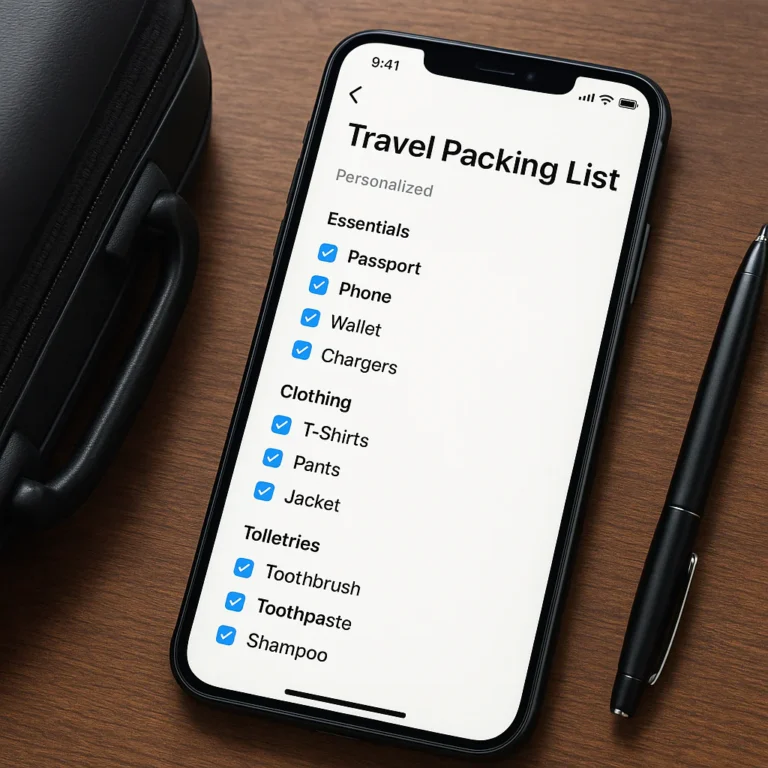
A checklist is most useful when you use it before the last-minute packing scramble. We recommend the Travel Checklist app to organize tasks by trip, keep essentials visible, and avoid relying on the memory of someone who is also trying to remember whether the iron is unpluged.
Before You Book and Before You Fly
Several weeks or more before departure:
- Check passport validity and entry requirements.
- Review vaccination and destination health advice.
- Confirm travel insurance coverage.
- Check airline baggage limits.
- Arrange roaming, an eSIM, or a local SIM plan.
- Ask your bank about card use abroad.
- Confirm medicine rules and prescription supply.
- Make accommodation and transport details accessible.
A few days before departure:
- Check the forecast and refine clothing.
- Download offline maps, tickets, and entertainment.
- Test chargers, adapters, headphones, and power banks.
- Confirm document backups.
- Refill prescriptions and assemble your medical kit.
- Share itinerary details with a trusted contact.
The Night-Before Checklist
- Put passport, wallet, medication, and phone together in your personal item.
- Charge your phone, headphones, and power bank.
- Check liquids and battery rules for your route.
- Add one change of clothes to your carry-on.
- Confirm airport departure time, terminal, and transport.
- Leave space for water to be filled after security.
- Make sure your luggage tags and trackers are set up.
A checklist app is especially helpful for repeat trips: keep a reusable international-travel list, then duplicate it and remove destination-specific items. That way you remember the adapter without packing five of them “just in case.”
❌ What Not to Pack for an Overseas Trip
Skip or reconsider:
- Unfamiliar medications or supplements you have never used before
- High-wattage appliances you have not checked for voltage compatibility
- Too many shoes serving the same purpose
- Bulky “just in case” items available at your destination
- Valuables you would be upset to lose
- Restricted foods, plants, or medicines without confirming entry rules
- A full-size bottle of every toiletry when small containers will do
- A filter bottle assumed to purify water when it is designed only to improve taste
- Every card and all cash in one wallet
A master list is for choosing from, not for packing every line. Your bag should match your trip—not your anxiety.
💡 Smart Packing Tips to Save Space and Avoid Extra Baggage
- Use a capsule wardrobe: choose colors and layers that mix easily.
- Wear your bulkiest shoes and outer layer on travel day if comfortable.
- Use packing cubes by category, not as an excuse to bring twice as much.
- Pack a small laundry kit for longer trips.
- Keep a little empty space for souvenirs and the inevitable extra snack.
- Weigh your bag at home if your airline enforces a weight limit.
- Keep essentials in your carry-on, especially medication and documents.
- Make a trip-specific checklist and review it twice: once while packing, once before leaving.
The first video recommends using zip-top bags for snacks, toiletries, wet items, or protecting electronics from rain. They can be handy, but reusable pouches are a more durable option for items you pack repeatedly. Its capsule-wardrobe rule—each bottom pairing with several tops—is a strong starting point, not a law enforced by airport security.
How can a checklist app help me avoid forgetting travel essentials?
A checklist app turns a broad packing plan into tasks you can complete and verify. Instead of trying to remember everything while packing, you can group items by documents, carry-on, electronics, health, and destination-specific gear.
With the Travel Checklist app, you can use a repeatable checklist as a starting point, then adjust it for each trip. The most useful habit is to mark items off only when they are physically packed or confirmed—not when you merely think, “Yes, I own that adapter.”
What travel essentials should I pack in my carry-on?
Carry your passport and entry documents, payment cards, medication, phone and charger, power bank, one change of clothes, and any health or mobility supplies you cannot easily replace. Add a small comfort kit with headphones, lip balm, hand cream, and an eye mask if you use them.
Keep these items in a bag you can reach without unpacking your entire cabin bag. Check the airline and airport rules for liquids, batteries, and special equipment before departure.
What are the must-have items for international travel?
The core essentials are valid travel documents, payment backups, medication, phone access, a compatible charging setup, and a carry-on plan for delays. Add clothing, shoes, hydration gear, and comfort items based on your destination and activities.
Optional favorites—such as an e-reader, camera, probiotic, or greens powder—can make a trip nicer, but they are not essential for everyone. Build from the core list, then personalize it.
What documents should I include in my international travel checklist?
Include your passport, required visa or travel authorization, flight and accommodation details, travel insurance information, relevant prescriptions or medical documentation, and emergency contact details. Add copies or secure digital backups, but protect sensitive files with access controls.
Check official entry rules for your destination and any transit countries. A visa that covers the final destination does not necessarily satisfy transit requirements.
Do I need a voltage converter or just a travel adapter?
You need a travel adapter when your plug shape does not fit the outlet. You may need a voltage converter if your device is not compatible with the destination’s voltage. Read the device label and manufacturer instructions before plugging it in.
Many phone chargers support multiple voltages; some hair appliances do not. A universal adapter is not automatically a converter.
How can I pack light for a two-week international trip?
Choose a small mix-and-match wardrobe, plan to do laundry, and limit yourself to shoes with distinct purposes. Use packing cubes for organization, not to cram in extra outfits. Repeat layers, pack travel-size toiletries, and check the weather and baggage limits before you leave.
For longer trips, laundry is usually lighter than packing a fresh outfit for every day. Build a list around your itinerary and remove anything you cannot explain using the phrase, “I need this because…”
How do I keep money and important documents safe while traveling?
Keep your passport and daily payment method secure, but store backup cards separately. Save secure document copies offline and share essential itinerary details with a trusted contact. Use accommodation safes when appropriate and avoid displaying valuables in crowded places.
A money belt is one possible storage method, not a complete security system. The video’s advice to split cards is more useful than putting every backup into one hidden pocket.
Conclusion

Recommended Links
Reference Links